A Groundbreaking Advance in Generative Vision Systems to Meet the Evolving Needs of Modern Creators
The last decade has witnessed a rapid and transformative evolution in generative vision systems. Models capable of producing coherent, semantically grounded, and visually rich images have successfully transitioned from experimental prototypes to widely adopted and essential creative tools. Concurrent with this technical progress, users have increasingly expressed a need for systems that can achieve more than just generating isolated, static scenes. Creators now expect tools that can maintain consistency across multiple outputs, deeply interpret personal context, and seamlessly support complex multimodal creative workflows.
At Robi Labs, we identified a critical, strong unmet need: a generative system capable of maintaining identity stability across subjects while simultaneously allowing flexible visual transformations across diverse scenes, styles, and contexts. The reality is that human subjects do not exist in a single context. When a creator desires to place themselves or a designed character within a fantasy world, a surreal environment, a historical setting, or a highly stylized visual domain, their core expectation is that the representation of the subject will remain visually coherent and intact. Prism was purposefully built to directly address this requirement. Rather than solely prioritizing visual novelty in a single shot, Prism focuses on delivering a coherent visual continuity across all scenes, empowering creators to leverage natural language and image guidance to generate complex, multi-scene narratives featuring subjects with stable, consistent identities. This design philosophy aligns perfectly with the broader research direction at Robi Labs, which centers on developing human-aligned generative systems where the generative AI adapts its behavior to a person’s identity, intention, and specific creative goals.
The Foundational Research Motivations and Core Philosophy Guiding the Development of Prism
Prism's development and design are firmly grounded in three essential core research motivations, each addressing a key limitation in predecessor generative models and outlining a forward-looking philosophy for creative AI.
Identity as a Stable and Reliable Creative Anchor for Coherent Multi-Scene Storytelling and Personal Branding
In the majority of contemporary generative systems, the visual representation of subjects tends to drift or degrade as contexts change. A person or character may suffer from altered facial features, inconsistent geometric shape, or different character traits after only a few minor prompt variations or scene recontextualizations. This inherent instability severely limits the usefulness of generative models for storytelling, character development, serial content, and personalized creative workflows. Prism directly tackles this by establishing identity alignment as a foundational, non-negotiable system property. The character's identity is treated as a stable anchor around which all creative transformations occur.
Natural Language as the Intuitive and Accessible Intent Interface for Democratizing Complex Image Modification
Traditional image editing workflows are often characterized by technical complexity, requiring manual adjustments, precise layering, masking, and a high degree of technical skill and specialized software knowledge. Prism is designed to radically simplify this process by enabling users to modify or generate images using only everyday, natural language descriptions. This intuitive approach significantly supports inclusivity, accessibility, and fosters low-barrier creative exploration for a much wider audience, moving technical complexity away from the user interface.
Multimodality as a Necessary Requirement for Richer Scene Understanding and Complex Creative Expression
Many modern generative tasks inherently demand the interpretation and synthesis of information from multiple modalities, including text, guiding images, and occasionally even audio context. Prism is designed with an inherent multimodal understanding at the user interaction level, allowing for sophisticated multi-input workflows and facilitating a richer, more nuanced form of creative expression that goes beyond simple text-to-image prompting.
A Comprehensive Overview of Observable System Capabilities Across Generation and Editing Workflows
Prism supports a wide and powerful set of generation and editing workflows. These capabilities are not internal design specifications but rather reflections of the model's consistently observable and predictable behavior when interacting with users.
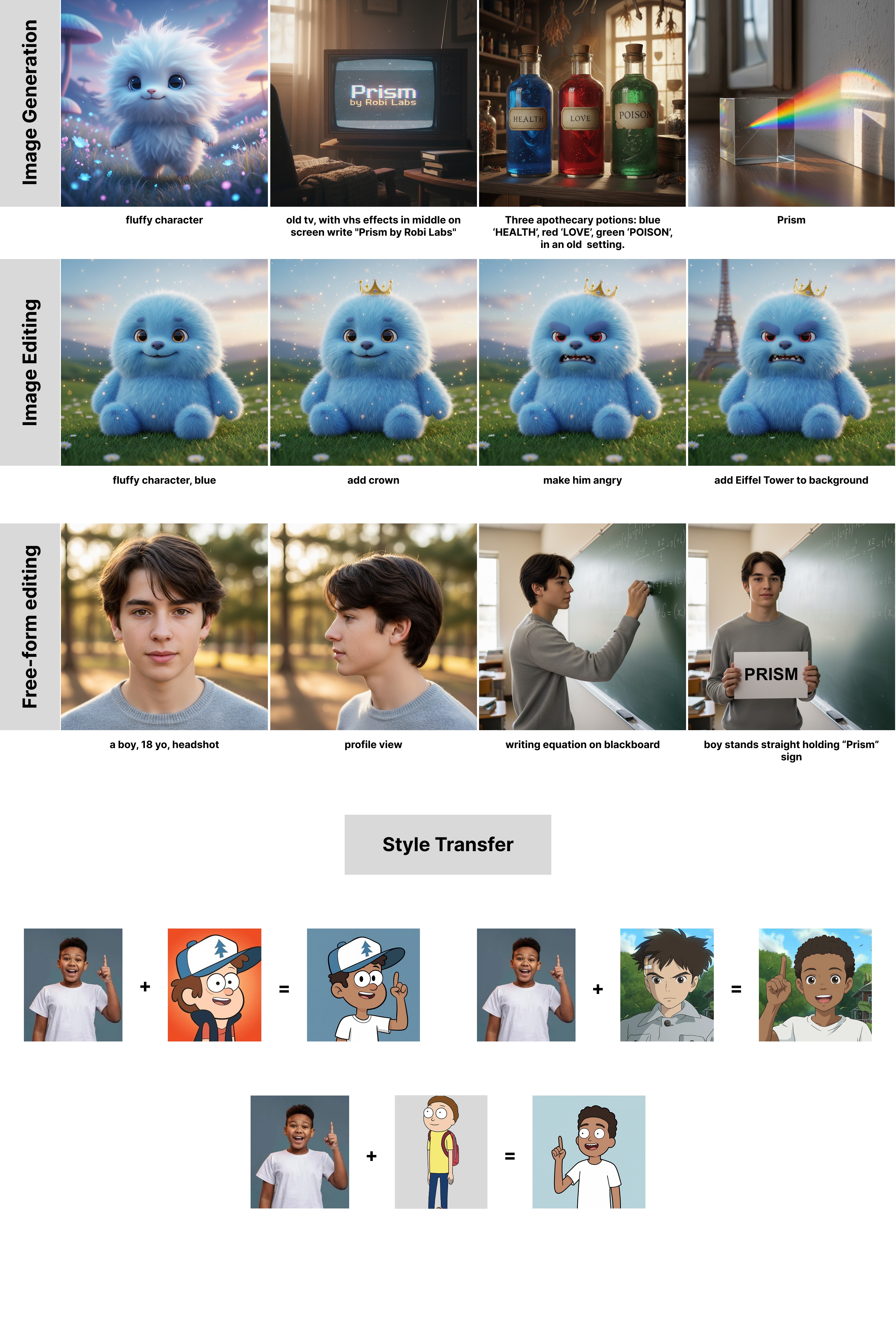
Text Guided Image Generation: Creating Novel Visuals from Pure Language Descriptions Users can initiate the creation of entirely new images based solely on natural language descriptions. Prism efficiently interprets the prompt's intent, identifies the necessary scene logic, and reconstructs a visually coherent image that is strongly aligned with the user’s narrative or aesthetic intent.
Natural Language Editing of Existing Images: Modifying and Reinterpreting Visuals with Simple Text Commands Prism empowers users to modify an existing input image using only text commands. This highly flexible capability includes executing stylistic changes, recontextualizing the entire scene, making lighting and color adjustments, subtly adjusting a character's pose or movement, and reinterpreting the surrounding environment.
Identity and Style Consistency: Preserving Character Coherence Across Diverse Scenes and Transformations This is one of Prism’s most defining and distinctive capabilities: the consistent, high-fidelity representation of the same character or subject across an entire sequence of multiple scenes and styles. This is particularly valuable in contexts such as multi-image narratives, the creation of creator identity visuals (avatars, profile pictures), brand persona development, character-based storytelling, and all forms of episodic or sequential creative tasks. Crucially, this consistency is preserved across significant variations in lighting, artistic style, compositional framing, and world context.
Multi Image Fusion: Synthesizing Unified Creative Results from Multiple Visual Inputs Prism is capable of accepting multiple images as creative input and intelligently merging them into unified, harmonized results. This capability supports advanced creative processes such as creating visual moodboards, executing concept blending between disparate ideas, achieving stylization through reference images, performing cross-scene reinterpretation, and facilitating hybrid creative workflows that combine photography and graphic design elements.
Adaptability Across Visual Styles: Generating High-Quality Output in a Wide Spectrum of Artistic Domains Prism demonstrates the ability to produce images across an extremely wide visual spectrum. This includes illustration, photorealistic realism, product imagery, sophisticated stylized art, conceptual environments like matte painting, and complex hybrid creative compositions. This broad adaptability makes Prism a suitable tool for both ambitious artistic endeavors and highly practical commercial applications.
A Conceptual View of the User Workflow: How Creators Interact with the Prism System
A high-level user workflow has been defined to illustrate the conceptual experience of interacting with Prism. It is important to note that this flow describes the user-facing interaction and does not disclose or describe any of the internal architectural components, training techniques, or proprietary implementation details.
Input: The user provides the creative prompt, which can be Text (a descriptive sentence), an Image (a base photo/visual), or a Multi-Image Set (for fusion and style transfer).
Prism Processing: The system takes the input and performs Multimodal Interpretation (understanding the combined text and visual intent) and Identity Alignment (fixing the subject's identity).
Output: Prism generates the final image, which is a High-Fidelity Visual exhibiting Identity Consistency and strong Prompt Fidelity.
This conceptual flow effectively reflects the streamlined, powerful experience of using Prism without necessitating the revelation of the underlying implementation.
Evaluation Methodology: Assessing Prism's Performance Based on Observable Output Behavior
Prism was rigorously evaluated using widely accepted community practices, with a focused emphasis on the observable behavior and quality of its final outputs. No internal model details were ever revealed or used during the testing phase, ensuring an objective assessment of the user experience.
Visual Quality Evaluation: Assessing Technical and Aesthetic Integrity of Generated Images Prism outputs were systematically assessed for key quality metrics: structural consistency of geometry and scenes, effectiveness of composition and framing, quality of lighting and color harmony, coherence between foreground and background elements, and overall visual realism or stylization quality.
Prompt Alignment Assessment: Testing Fidelity Across Diverse Intent and Complexity Levels Evaluation categories were broad and included: complex character descriptions, detailed environmental scenes, product-focused prompts, abstract creative transformations, intricate hybrid composition tasks, and contextual or narrative prompts. Prism consistently demonstrated strong performance across both highly literal and artistically open-ended prompts.
Human Preference Studies: Benchmarking Prism Against Alternative Generative Baselines Independent human evaluation panels were used to compare Prism's outputs against leading alternative generative baselines. Participants were deliberately not informed about which model generated which output (a double-blind approach). Categories for comparison included: character consistency, creative preference, scene reinterpretation quality, editing coherence, and overall prompt fidelity. Prism scored exceptionally high in tasks that required robust character alignment and persistent identity.
Multi Input Consistency Evaluation: Validating the Success of Complex Image Fusion Tasks Prism’s multi-image fusion capabilities were evaluated specifically for: structural coherence between blended elements, success in style harmonization, the quality of conceptual integration between the various source images, and the overall creative interpretability of the final merged output.
Practical Use Cases and Key Application Domains for the Prism System
Prism is designed for utility in both advanced research and demanding real-world creative applications, making it a powerful asset across multiple industries.
Visual Storytelling and Narrative Design: Creating Coherent Multi-Scene Character Journeys Prism excels in supporting sequential creative workflows where the same character must appear consistently across drastically different scenes, environments, or time periods—an essential capability for film pre-visualization, comic book creation, and narrative game design.
Design and Concept Ideation: Accelerating the Early Stage of Visual Experimentation The early stage of ideation can be significantly accelerated through Prism's ability to rapidly generate exploratory scenes, varied product concepts, visual experiments, and mockups with character context.
Marketing and Branding Assets: Ensuring Visual Continuity and Identity Coherence for Campaigns Prism can provide vital assistance in generating brand-aligned visuals, creating thematic environments, contextualizing products in various settings, and producing high-quality campaign-based creative materials with consistent human or character subjects.
World Building for Entertainment: Exploring and Designing Immersive Character-Driven Environments Game developers, speculative writers, and concept artists can leverage Prism for rapid world exploration, testing various stylistic treatments, and designing character-driven environmental concepts.
Education and Communication: Visualizing Complex Concepts Through Natural Language Illustration Educators, communicators, and instructional designers can use Prism to rapidly illustrate complex or abstract ideas visually through simple natural language commands, making otherwise inaccessible concepts clear and engaging.
User-Facing Strengths and Current Limitations: A Transparent View of Prism's Observed Behavior
The following summary captures Prism’s high-level strengths and its known limitations, providing a transparent look at the system's observed behavior across extensive evaluation sets.
Observable Strengths Reflecting High-Performance Creative Utility
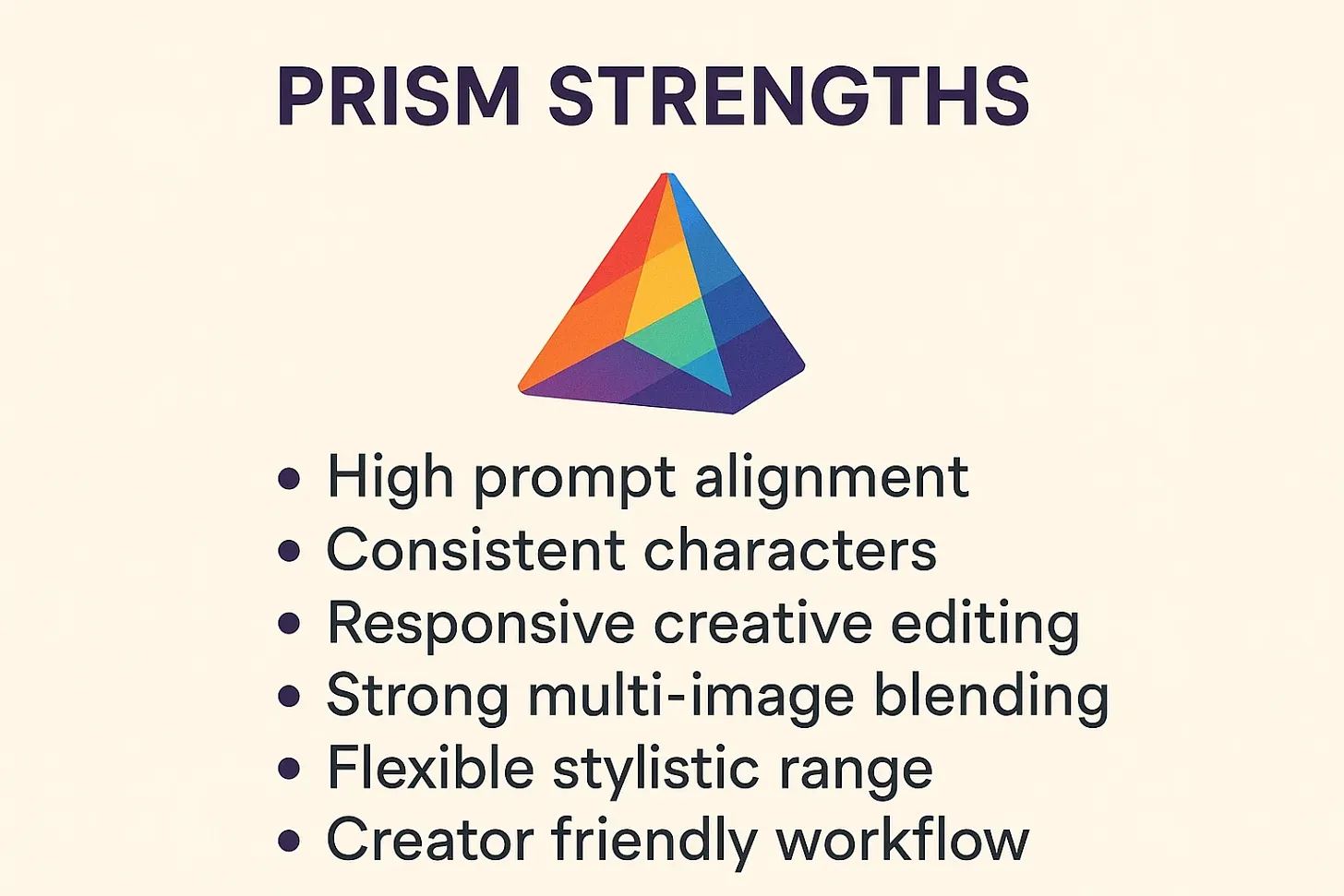
Prism’s core strength lies in its identity-aligned generative modeling, which ensures that characters remain visually consistent through diverse scene transformations. The natural language-driven editing process is a key strength, providing a low-friction interface for complex modifications. Furthermore, its demonstrated high prompt fidelity ensures that outputs reliably match the user's detailed intent, and its seamless multimodal integration handles combined text and image inputs with exceptional coherence.
Known Limitations and Areas for Future Development in Generative Technology
As is the case with all current generative models, Prism has known limitations that guide future research:
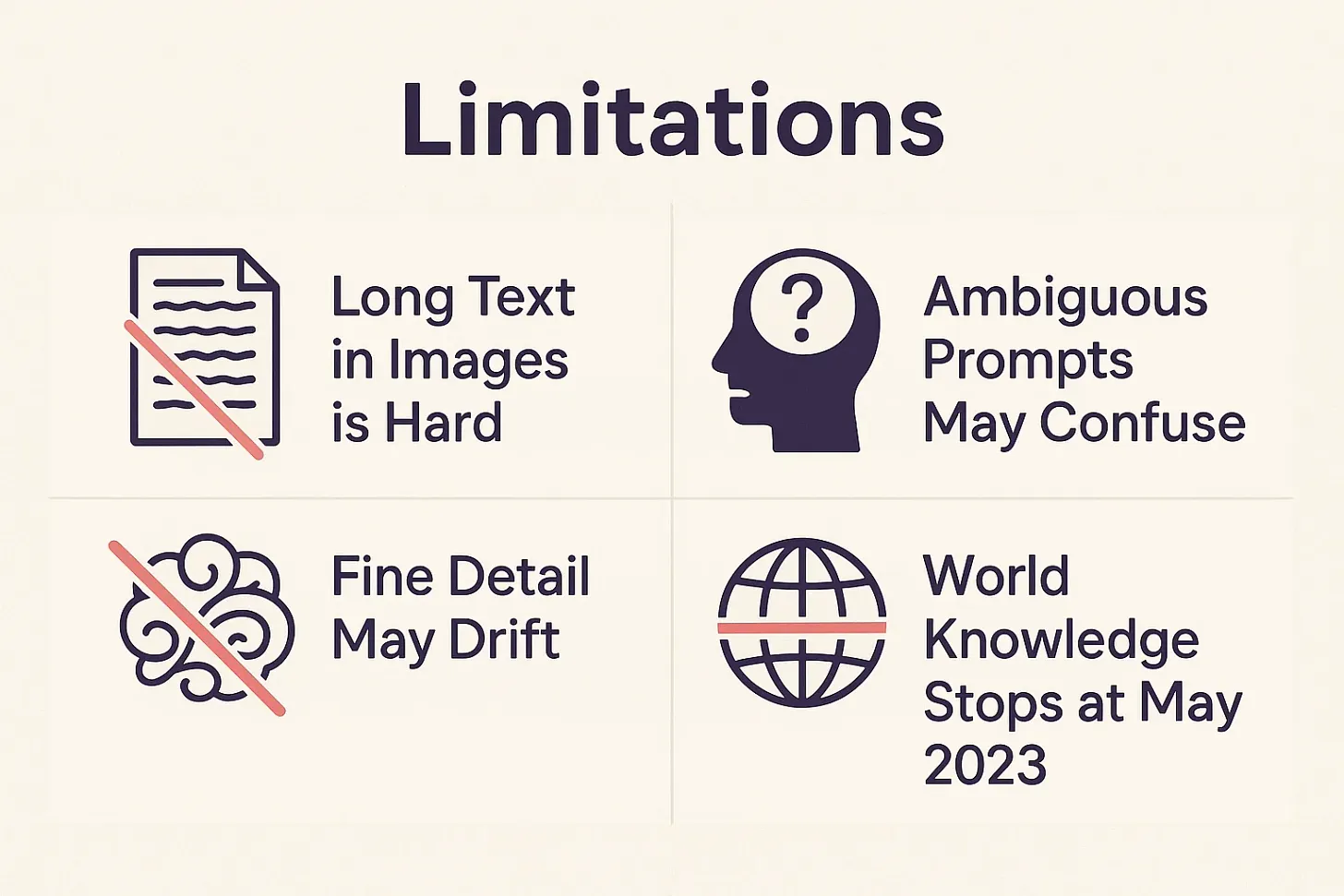
Text Rendering in Images: Prism may struggle with rendering long, complex, or multi-line text blocks within generated images. Long sentences, readable paragraphs, or detailed signage can occasionally appear distorted or unintelligible.
Fine-Grained Object Detail: Extremely precise details, such as micro-labels, specific real-world logos, or complex, very specific surface textures, may sometimes be simplified or deviate slightly from absolute real-world accuracy.
Ambiguous or Layered Prompts: Highly complex, extremely layered, or inherently ambiguous instructions can occasionally lead to interpretation errors or the generation of "hallucinated" elements that were not explicitly requested.
Temporal Knowledge Cutoff: Prism reflects information, styles, and world knowledge up to May 2025 and does not contain any knowledge or data acquired beyond that date.
Responsible AI Considerations and Future Research Directions at Robi Labs
Robi Labs maintains a steadfast commitment to the responsible development and deployment of generative systems. Our research teams strictly adhere to safety-aligned practices during all phases of model evaluation and user guidance development.
Ongoing Responsible AI Research and Safety-Aligned Practices
Topics under constant, ongoing study include: identity and representation ethics within generated content, the critical importance of consent in generative media workflows, the establishment of clear authenticity and disclosure standards, implementation of robust safety-aligned prompt handling, and effective misuse mitigation strategies achieved through comprehensive user education. Prism is released with detailed usage guidelines to actively support safe, ethical, and responsible creative work by all users.
Future Research Paths Paved by the Prism System Architecture
Prism serves as a powerful foundation, opening multiple high-impact pathways for continued research at Robi Labs:
Multimodal Expansion: Future iterations of Prism are planned to incorporate deeper multimodal reasoning, enabling richer scene understanding and more powerful, cross-modal creative synthesis that potentially includes audio and video.
Long-Form Visual Composition: Significant research is underway to develop support for coherent, extended multi-image sequences, true long-form narratives, and world-scale visual continuity across hundreds of frames.
Interactive Visual Reasoning: We aim to explore systems capable of not only maintaining persistent character identity but also performing complex, stepwise reasoning within dynamic visual contexts.
Adaptive Style Transfer and Learning: Future work will involve adaptive identity-aligned style modeling, where characters can seamlessly adopt artistic or cultural aesthetics without any degradation of their core identity.
Enhanced Real World Alignment: We are researching improved grounding methods to better model real-world object behavior, environmental composition, and highly accurate, light-based realism.
Conclusion: Prism as the Foundation for Personalized and Identity-Aligned Generative Modeling
Prism represents a significant and demonstrable step forward in the field of identity-aligned generative modeling developed at Robi Labs. It successfully delivers powerful natural language image generation, ensures consistent subject representation across scenes, facilitates advanced multi-image blending, and supports a wide range of creative reinterpretation workflows. Comprehensive evaluation results have consistently demonstrated strong performance in core areas: prompt alignment fidelity, subject identity stability, and overall creative preference tasks.
This research report has transparently outlined Prism from a high-level conceptual and behavioral perspective, maintaining our commitment to responsible disclosure by withholding proprietary internal implementation details. Robi Labs will continue its mission to advance multimodal generative systems with an unwavering focus on human alignment, creative reliability, and responsible innovation. Prism stands as the crucial foundation for our future research directions in personalized visual generation, human-centered creativity, and adaptive multimodal intelligence.
About author
Robi Labs is an independent AI research company creating next-generation models and tools like Lexa, Picasoe, Framex, Echo, Mira, and MoVi. Our mission is to make AI more human-centric, accessible, and impactful for creators, educators, and developers worldwide.

Robi Labs Team
General
Subscribe to our newsletter
Sign up to get the most recent blog articles in your email every week.